
How to Search Criminal Dockets
Utah Xchange is the main remote tool for Uintah County criminal dockets. Select both court types when the offense level is unknown. A District-only query can miss a Class B or C misdemeanor. A Justice-only query can miss a felony or Class A misdemeanor. Use the full case number whenever you have it. For names, try the exact spelling first. Then add the official asterisk wildcard for likely variants. Common names get clearer when you filter by Uintah County, court location, case type, and date.
Case numbers repeat across the state. Pair the number with Uintah County or the known court. A blank result is not the last word. Recent CORIS entries may lag in Xchange. Older Justice Court data can be thin, or the record may simply not be public. The clerk's counter and a public CORIS terminal are solid backups. Call the court before you drive over. Send a written request when the docket points to a public file that is not online.
- Open Xchange and choose District Court, Justice Court, or both.
- Set Uintah County or the known Vernal location, then enter the number or name.
- Check the court, case type, filing date, and party role.
- Read charges, proceedings, plea, disposition, and account fields separately.
- Ask the clerk for inspection or a copy if a public item is absent online.
Uintah Criminal Docket Search Limits
Xchange pulls from the Utah Court Information System once local staff enter each event, so it is a case-history source rather than a live mirror. Vernal joined statewide Justice Court coverage on October 28, 1996, but the official coverage history cautions that older records can be incomplete, because each Justice Court converted on its own schedule.
No result has several meanings. Recheck spelling, court level, date filters, and location. An entry may be delayed, an old record may be incomplete, or access may be restricted.
Results can cap at 500. Tight filters sharpen a Uintah County criminal docket search and cut the risk of mixing up people with similar names, so never treat a public name match as a criminal history report.
What a Criminal Docket Shows
A Uintah County criminal docket can show the court, case type, number, filing date, parties and roles, judge, counsel, charges, class, prosecution and law-enforcement fields, citation, violation date, plea, disposition, due dates, account summary, and chronological proceedings. Not every public case fills every field. A document link is not the same as case history. Public electronic documents may require purchase.
| Case Number | A Utah identifier that must be paired with county and court because it is not unique statewide. |
|---|---|
| Case Type | FS is state felony, MO other misdemeanor, MD misdemeanor DUI, and IF infraction. |
| Charge | The alleged offense and level for that count, not a finding of guilt. |
| Dates | Violation date marks the alleged event; filing date marks court entry. |
| Plea and Disposition | Separate fields. Match each outcome to the correct charge. |
| Proceedings | Chronological settings and events, not every internal clerk act. |
Read the labels exactly. Several charges in one case can end differently, and a balance due is a money figure, not a legal result.
Uintah Criminal Docket Codes
The official Xchange code table identifies case categories. Codes repeat with different meanings across fields, so keep the full phrase rather than expanding letters from memory.
- GP
- Guilty plea when that full label appears.
- NC
- No contest in the stated context.
- PA
- Plea in abeyance, not an immediate dismissal.
- DV
- Diversion when shown in the record.
- D or DI
- Dismissal codes whose full labels state with or without prejudice.
- CS
- Criminal sentence in a judgment context.
"Pending" means unresolved at a stated time. "Transferred" and "remanded" mark procedural moves, and none of these codes should be stretched into a broader conclusion.
Note: Display the official description beside each code because identical letters can mean different things in separate Xchange fields.
Stages on a Criminal Docket
The docket begins at filing or entry. Arraignment records the first formal plea stage. Pretrial settings may cover status, motions, discovery, plea talks, or trial preparation, and a plea can resolve some counts while others remain open. Trial entries record the type and later result. The disposition states what happened to a specific charge, while sentencing, restitution, appeals, and post-judgment motions can extend the history with later judgments.
Docket flow: Filing → Arraignment → Pretrial → Plea or Trial → Disposition → Sentencing
A setting does not prove the event occurred. Confirm the hearing in the Utah Courts calendar, then check the result in Xchange or the court file.
Uintah Criminal Filers and Parties
Utah's e-filing system serves attorneys and approved filers, not the general public, and it is not a docket search. The official e-filing portal shows the filer login and account context.
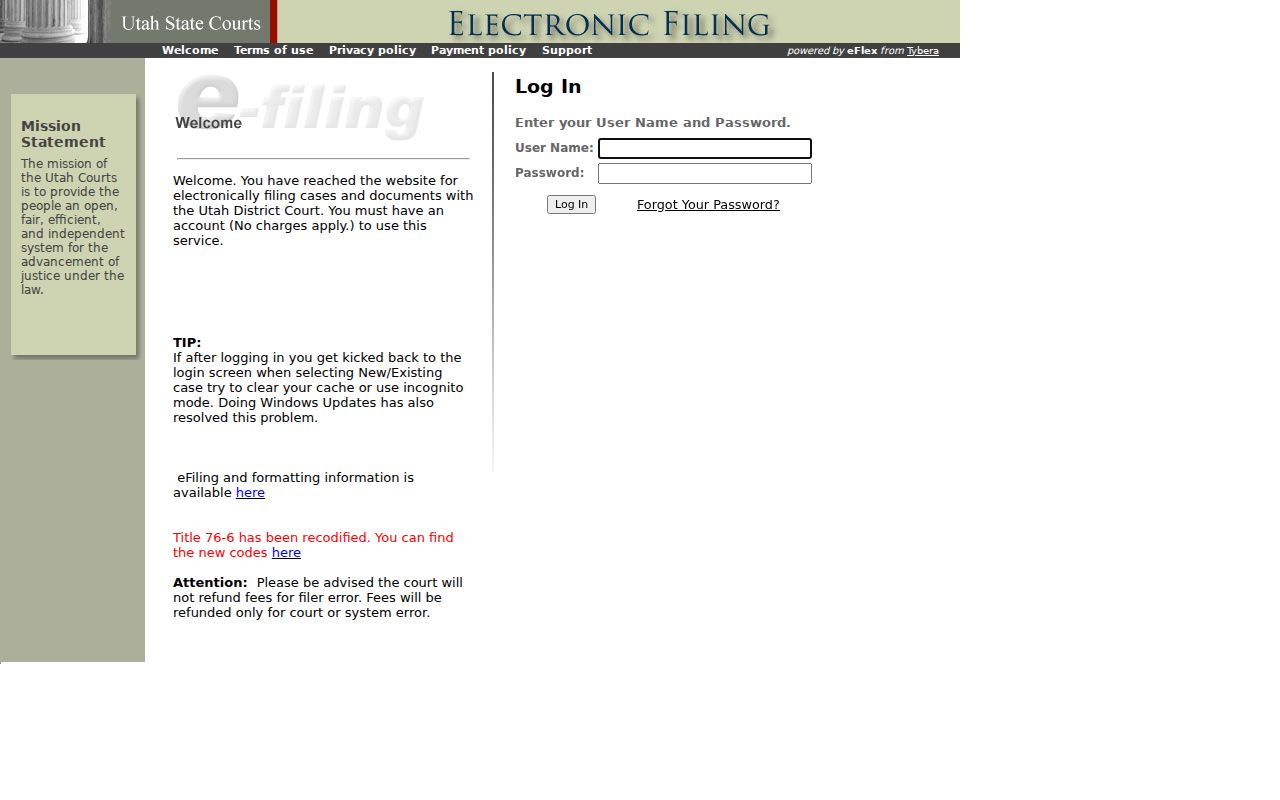
The screen separates submitting a Uintah County criminal filing from reading it later in Xchange. E-filing carries no service charge per the landing page. Filing and service obligations may still apply.
Parties and authorized users can turn to MyCase for their own linked case, papers, payments, history, and notices. The Utah Courts MyCase description explains that role.
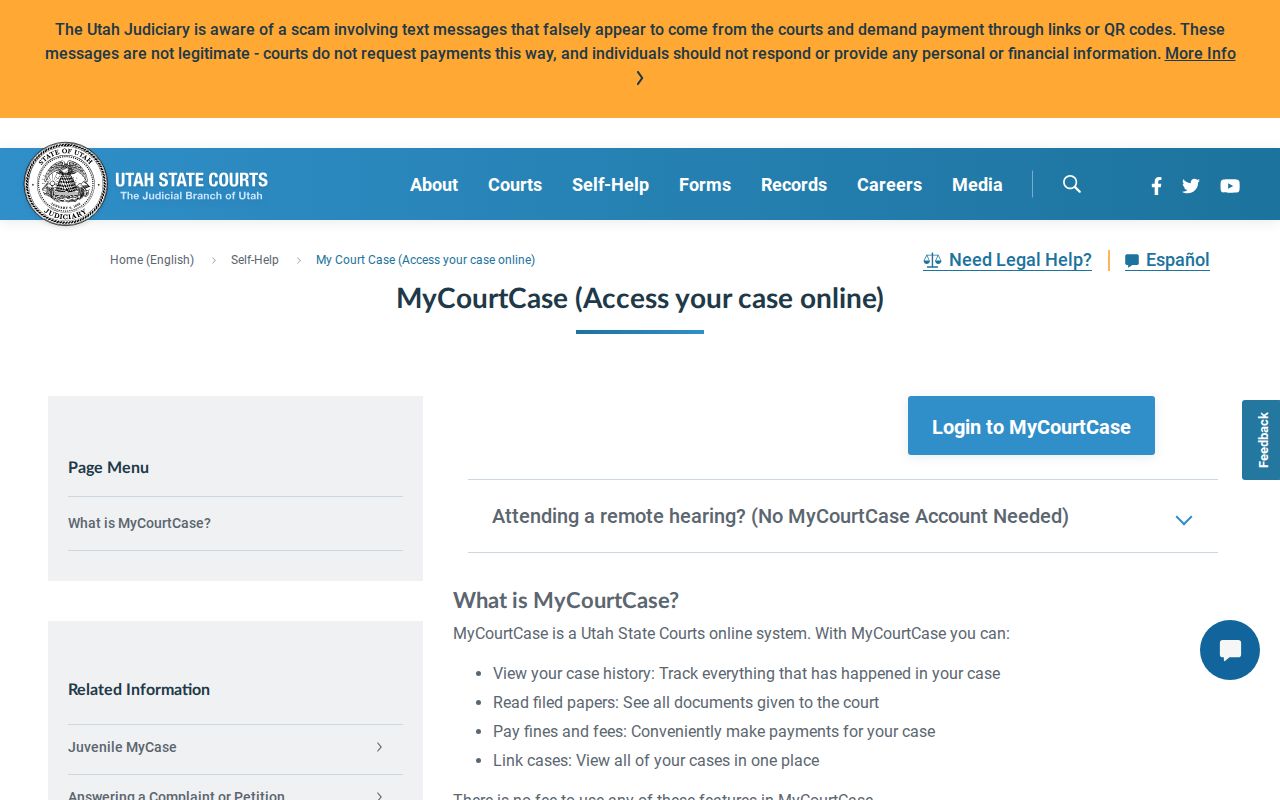
That party route requires identity and case-linking details, so it is no broad name index. Public researchers should stick with Xchange, the calendar, the clerk, or a public terminal.
Which Court Holds Criminal Dockets
The Utah District Court hears all felonies and Class A misdemeanors, and Uintah County sits in the Eighth Judicial District. Justice Courts ordinarily handle Class B and C misdemeanors, infractions, traffic matters, and city or county ordinances. When labels differ, the caption, case type, and location control.
| Court | Criminal scope | Public route |
|---|---|---|
| Vernal District Court | Felonies and Class A misdemeanors | Xchange, calendar, clerk, CORIS terminal |
| Uintah County Justice Court | Class B/C misdemeanors and infractions | Xchange, calendar, court contact |
| Vernal Justice Court | Municipal limited-jurisdiction matters | Xchange, calendar, official Vernal page |
Federal criminal cases belong to the District of Utah and PACER, not Xchange. Juvenile delinquency has no ordinary public Xchange route.
Uintah Criminal Docket Workload
Official FY2023 data reported 841 criminal filings and 864 dispositions in Uintah District Court. State felony matters ran 478 filed and 494 disposed. Other misdemeanors were 288 filed and 312 disposed. Misdemeanor DUI was 41 filed and 39 disposed. These are court-flow counts, not counts of people or convictions.
A ratio above 100 percent does not measure conviction, since courts dispose of cases filed in prior periods. The FY2026 Q2 Justice figure is active inventory, not new offenses during the quarter.
Uintah Criminal Docket Programs
Uintah County has started a pretrial supervision program, according to the 2024 Utah Courts Annual Report. That is where the detail ends. The report gives no local eligibility rules, supervision conditions, provider names, or enrollment steps. A Uintah County criminal docket may list a pretrial event. So treat the entry as a lead. Bring live questions straight to the court.
Judge Greg Lamb's official biography lists a Uintah County Drug Court assignment. That confirms the specialty docket exists locally, nothing more. It says nothing about admission standards, how long the program runs, success rates, or confidentiality rules. Run a docket search on the public case history first. Then contact the court for current procedure. Participation can never be inferred from a single setting label on a docket sheet.
Read program entries the same neutral way you would read any other Uintah County court docket event. A referral, review hearing, status conference, or supervision note only proves the court scheduled or recorded a step. It proves no completion, compliance, termination, or final outcome. Later docket events can change the status. Some details behind an entry stay restricted. Match each entry to its date and read what follows it. Rely on the full official label. When eligibility or a current condition truly matters, the case order and the court beat a short public index entry every time.
Public Access and Sealed Criminal Dockets
Utah sorts court records into four buckets: public, private, protected, and sealed. A public Uintah County criminal docket can list charges, hearings, pleas, dispositions, and sentences. Public access does not permit wide republication of birth dates, addresses, victim details, or other protected identifiers. And remember the basics: charges stay allegations until resolved. A disposition may cover just one count.
Key access rules:
UCJA Rule 4-202.02 classifies public, private, protected, and sealed records.
UCJA Rule 4-202.03 permits public access while requiring authority for non-public material.
UCJA Rule 4-202.04 governs written requests and access procedure.
Xchange leaves out sealed, expunged, juvenile, civil-commitment, adoption, and other restricted matters. Dismissal alone is not expungement. If a public docket entry looks wrong, hand the clerk the case number, county, location, and the field you question.