
How to Get Court Records
Start remote. The statewide Utah Xchange portal opens public District Court and Justice Court information to anyone. That includes case history and some images you can buy. It still is not the clerk's full file. For Uintah County District Court material, the place to call is Vernal District Court. The address is 920 East Highway 40, Vernal, Utah 84078, phone 435-781-9300. Justice Court questions go to the court named in the case caption. The Vernal directory lists Uintah County Justice Court at 641 East 300 South, Suite 100, Vernal. That phone is 435-781-5338.
Utah's record-request instructions cover two more routes. One is inspecting a file at the courthouse. The other is sending the official written form by mail or hand delivery. A quick phone call can confirm the right office. It can also confirm the file's location, current hours, and likely cost. Detailed or non-public requests may still need signed paperwork. Many court locations also offer public CORIS terminals. Uintah availability is worth confirming before a trip.
- Identify the court, case number, parties, and filing or hearing date.
- Check Xchange for the public history and available electronic papers.
- Ask the proper clerk whether inspection, mail, or a written form fits the item.
- Describe the record and state whether a plain or certified copy is needed.
- Confirm fees and delivery before added research or copying begins.
Uintah Written Request Workflow
Uintah County's official Request for a Record form wants a few practical things from you. List your contact details and describe the specific record you want. Then pick inspection or copies. There are also boxes to request expedited handling. You can ask for a fee waiver, or explain your basis for access when a record is not public. Checking those boxes grants nothing by itself. They simply give the clerk the facts needed to apply Utah court rules to your docket request.
Plan on a response within ten business days. A qualifying expedited request made for public benefit can shorten that to five business days. Even so, these are response windows rather than delivery promises. The clerk may ask for clarification, estimate charges, release the portions that are accessible, or explain a restriction. One tip works well here. Ask for a single named order on a known date rather than a sweeping demand for everything about a person.
Request safely: Include court location, case number, document title, and date range. Do not send Social Security numbers, payment-card data, or unrelated private details.
Types of Court Records
Not every piece of a Uintah County court record lives in one place. Xchange gives you the index plus a running history of events. The clerk's office keeps the deeper papers. Those can include pleadings, motions, orders, judgments, and exhibits. There are also files that are simply never sold online. The Utah Courts records hub adds another split worth knowing. It keeps current case records apart from archives, weekly reports, and recordings. A docket search there leads to more than one kind of material.
- Docket entries showing filings, proceedings, settings, and dispositions.
- Public pleadings, motions, orders, decrees, judgments, and document images.
- Audio or video records when the court created a recording.
- Certified copies bearing the clerk's authentication.
- Archived files that require retrieval instead of an instant download.
Some cases never touch a Uintah County docket at all. Federal civil, criminal, and bankruptcy files sit in PACER and the federal court that handled them, not in a state-court file. Tribal matters work the same way. Their records come from an official tribal source. A case's geography alone will never place it in Utah Xchange.
Xchange Is Not the File
Utah's Xchange overview calls the system a repository. CORIS, the Utah Court Information System, feeds it. Clerks type in each entry, and the docket shows it only after that entry is made. So the Xchange record can trail the clerk's paper file when a new filing, disposition, citation, or order lands. Coverage of older Justice Court matters is uneven, since local courts came online at their own pace. Vernal joined the statewide system on October 28, 1996. The coverage notice still cautions that earlier records may be incomplete.
| Route | Best For | Limit |
|---|---|---|
| Xchange | Public history and available images | Not the complete file |
| CORIS terminal | Public courthouse search | Confirm local availability |
| Court clerk | Inspection, copies, certification | Rules and fees apply |
| MyCase | A party's own linked case | Not a public name search |
MyCase serves authorized parties who need their own linked matters, and e-filing handles filing and service. Neither one fills the role of a public records request for Uintah County court records.
What a Court Record Contains
Read a Uintah County court record one field at a time. A party label tells you a role. It assigns no blame. A charge is an allegation, not a finding of guilt. Dates matter too: the filing date and the event date can differ, and a single disposition may cover just one count. For identifying the case, the court label often beats the county field, because District Court and Justice Court handle different kinds of matters.
| Case number | The identifier, used with the court location. |
|---|---|
| Case type | An official civil, criminal, traffic, probate, or other code. |
| Parties | Names and roles such as plaintiff, defendant, petitioner, or respondent. |
| Proceedings | Public events, filings, hearings, and due dates. |
| Disposition | The official result, which may cover one charge or claim. |
| Documents | Public images may be purchased; availability varies. |
| Account summary | Displayed fines, fees, payments, and balances. |
One code can mean two things. Some letters shift meaning from one court list to the next, so a Uintah County docket entry should be read against the official case-code table instead of memory. Full labels beat guesses. Remember that a search result shows public case information only; it does not surface every paper filed or every clerk action taken behind the counter.
Uintah Audio and Transcript Route
Audio from a hearing is its own court record. Utah's transcript and recording instructions draw a clear line. One side is asking the court for a recording. The other is ordering a transcript written from it. The Eighth District form wants the caption, case number, judge, date, courtroom, delivery format, and your contact information. Staff use those details to pull the right Vernal District Court proceeding.
What you can get depends on what the court actually recorded. It also depends on whether that proceeding is public. A docket search will not hand you a transcript on its own. Before paying, confirm the current form. Also confirm the processing time, the delivery method, and the transcript cost.
Certified Copies and Fees
The clerk treats portal use and in-person service very differently. The fee schedule reflects that. The Xchange fee page shows a $25 one-time setup. Then $5 buys up to ten searches. Each added search runs $0.35, and a clerk-researched document runs $1. Heavier users pay $40 a month for up to 500 searches. Anything past that is billed at $0.15 each. Fees like these change, so check the live page before you budget for docket work.
| Item | Published Amount | Application |
|---|---|---|
| Paper copy | $0.25 per sheet | Clerk copy charge |
| Staff time | $22 per hour | After the first 15 minutes |
| Certified copy | $4 per document | Added to copy cost |
| Mailing | Actual cost | Postage or delivery |
Authentication: Uintah County sets no separate exemplification or apostille fee, so ask the receiving office what form of authentication it actually needs. The official request page spells out how the court responds to a records request and what it charges.
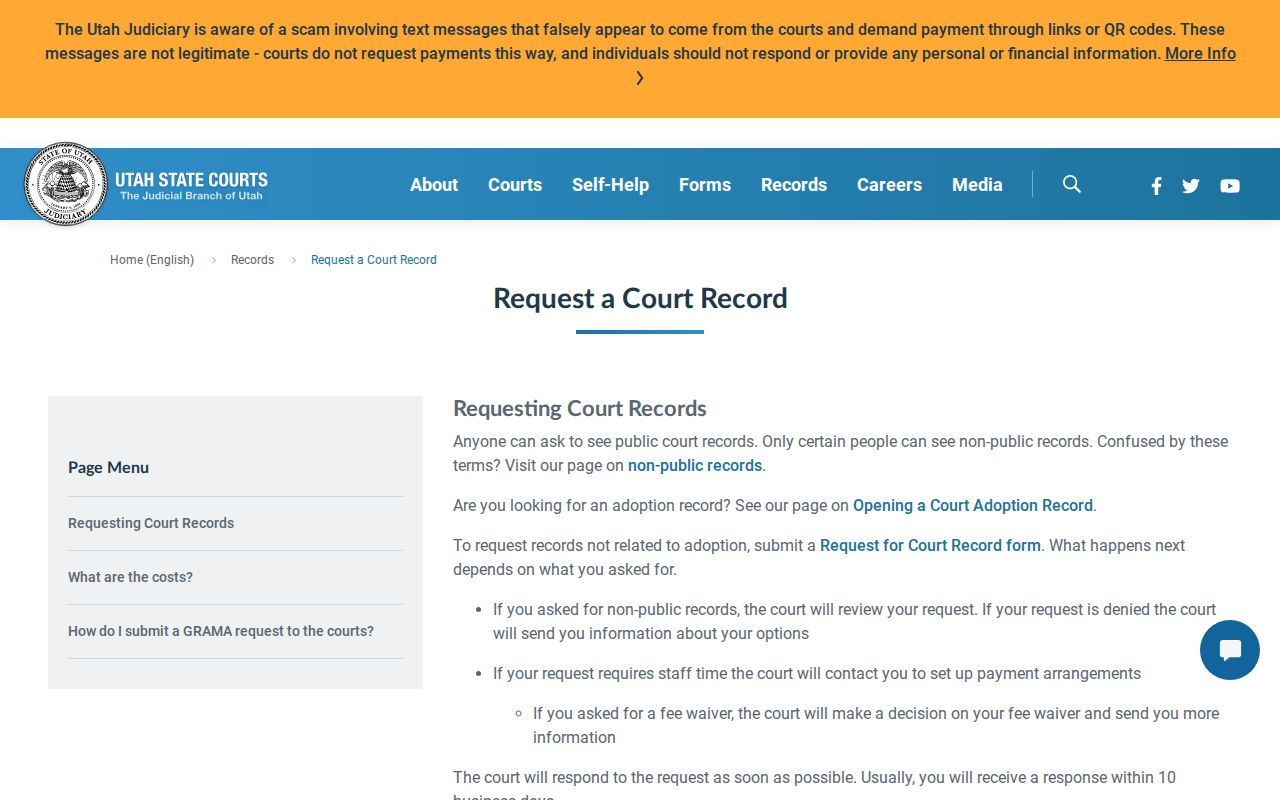
A precise description of the record you want keeps the clerk's search tight and the fee predictable. Confirm current costs with the clerk's office before staff begin any broad research into the court docket.
Public Access and Sealed Records
Utah sorts access questions mainly through court rules. Rule 4-202.02 puts every record into one of four classes: public, private, protected, or sealed. Rule 4-202.03 explains who may see what, and Rule 4-202.04 sets out how to make a written request. The Government Records Access and Management Act sits behind all of this. It supplies broader public-record principles.
Access boundary: Xchange omits sealed and expunged cases, adoption, civil commitment, juvenile delinquency, child-welfare, termination matters, and other protected categories. Not displayed does not mean nonexistent.
Domestic matters are where the nuance shows up. The case category might be private, yet pieces of the file can stay in view. Public history, hearing notices, judgments, orders, decrees, and letters of appointment all remain open unless a specific restriction applies.
What if you want an item that is not public? State your basis for access in the request. The court then decides whether you qualify.
Vernal District Court Clerk
920 East Highway 40
Vernal, UT 84078
435-781-9300
Confirm the custodian, hours, file location, and current charges before visiting.
When a Uintah Record Is Missing
A blank Xchange screen does not prove the Uintah County court record is gone. Try the name again. Use different spellings, party variants, the case number, the court location, and the case type. Sometimes a fresh filing sits in a queue waiting for staff to enter it. Some older Justice Court matters simply predate full conversion. Sealed, expunged, private, protected, juvenile, federal, and tribal records also fall outside the index.
When in doubt, call the court listed on your notice or filing. The clerk may be able to confirm the right location and request route. That happens without revealing protected facts. Parties working on their own cases can turn to Utah MyCase. Keeping these systems separate matters. An incomplete index should never be mistaken for a final answer about a Uintah County case.
Uintah Filing Access Boundaries
Filing a paper and searching the docket are two different jobs in Utah. The state e-filing system exists so approved filers can submit and serve court documents. It is not a public docket search. It was never built for one. A filing accepted there may later show up as a public docket entry. The document itself stays offline or keeps a restricted court-record classification.
So match yourself to the right door. People involved in their own cases can use MyCase when they qualify. Everyone else should search Uintah County court records through Xchange, a CORIS terminal, or a clerk request. That way nobody opens an e-filing account by mistake. Filing credentials stay separate from public docket research.